
What General Counsel Should Ask Santa For
22 Dec, 20256 minutes

What General Counsel Should Ask Santa For
A practical AI wishlist for modern in-house legal leadership
If you’re a General Counsel or senior legal counsel heading into 2025, you don’t need another article telling you that AI is “coming for legal”.
It’s already here.
The more useful question now is this:
Which tools genuinely make the GC role clearer, calmer, and more strategic and which ones just add noise?
For anyone leading an in house legal function, the answer isn’t more tech for tech’s sake. It’s a carefully chosen AI toolkit that reduces friction, protects judgment time, and helps legal operate at the level the business increasingly expects.
So, if Santa were building the ultimate AI wishlist for General Counsel this year, here’s what should actually be in the sack.
First on the list: something to tame the inbox
Legal risk doesn’t arrive labelled “urgent legal issue”.
It arrives as an email. Or twenty. Or a Slack message at 6:47pm.
For most General Counsel, the inbox has become the collision point for urgency, politics, operational noise, and genuine legal risk. Tools like Fyxer AI earn their place here not because they’re flashy, but because they’re practical. Prioritising what truly matters, drafting sensible replies in your tone, and reducing constant context-switching helps preserve something increasingly rare for senior legal leaders: thinking space.
For in house legal teams, this isn’t about replying faster. It’s about protecting judgment.
An AI thinking partner, not just a drafting shortcut
Most legal teams now have access to generative AI. What separates strong legal counsel from overwhelmed ones in 2025 is how it’s used.
Tools like ChatGPT or Claude work best when treated as thinking partners rather than shortcuts. They’re excellent for:
- First-pass drafting
- Summarising dense materials
- Pressure-testing arguments
- Translating legal nuance into executive language
Used properly, they can sharpen your legal judgement. And for a General Counsel sitting at the intersection of legal, commercial, and strategic decision-making, that sharpening matters.
Contracts still matter- so make them scale
No GC escapes contracts. Volume increases, turnaround expectations accelerate, but risk tolerance cannot slip.
This is where specialist legal technology like LexCheck fits naturally. By reviewing contracts against internal standards quickly and consistently, it flags risk and deviation without turning every agreement into a bespoke redlining exercise.
The real value isn’t speed for speed’s sake, it’s consistency at scale, something every growing organisation needs from its in house legal function.
Knowledge shouldn’t live in people’s heads
One of the quietest risks in in house legal teams is institutional memory loss. When knowledge lives in inboxes, personal folders, or individual experience, organisations become exposed the moment people move on.
Platforms like iManage, enhanced with AI-driven search, solve this problem head-on. They make legal knowledge secure, searchable, and durable.
For a General Counsel, this isn’t document management, it’s resilience. And resilience is increasingly critical across in house legal jobs, where teams are leaner and expectations higher.
Visibility beats heroics
Modern in house legal teams manage portfolios, not just matters. Regulatory change, disputes, transactions, internal initiatives, all competing for limited capacity.
Used thoughtfully, tools like ClickUp provide visibility over deadlines, ownership, and progress, often enhanced by AI summaries that surface risk early.
This isn’t micromanagement. It’s how legal shifts from reactive firefighting to genuine strategic partnership, something every GC is now expected to deliver.
Governance lives in structure, not policy
Some of the biggest legal and compliance failures don’t stem from bad advice, but from unclear accountability.
ComplexChaos earns its place here by mapping how decisions are actually made across an organisation and where responsibility really sits.
For General Counsel involved in governance, scaling, or transformation, this kind of clarity is invaluable. It answers the question every legal leader dreads after the fact:
“Who was supposed to own this?”
If it wasn’t recorded, it didn’t happen
Meetings are where decisions are made and where they’re later misunderstood.
Tools like Fireflies.ai or Otter.ai quietly solve this by capturing discussions, summarising outcomes, and creating a searchable record of decisions and actions.
For legal counsel, this isn’t surveillance. It’s accuracy, defensibility, and institutional memory, especially when decisions are revisited months later under pressure.
Research without the rabbit hole
Not every question needs a 20-page memo. Sometimes a GC just needs to get oriented quickly.
Perplexity AI excels here, offering fast, structured answers with clear sources. It’s ideal for understanding new regulatory areas, unfamiliar markets, or emerging risks before deciding whether deeper analysis is required.
In a role defined by prioritisation, that kind of clarity is a genuine gift.
Understanding the tech stack
None of these tools are “must-haves” in isolation. But together, they form a legal technology stack that reduces noise, protects thinking time, and allows in house legal teams to operate with clarity and confidence.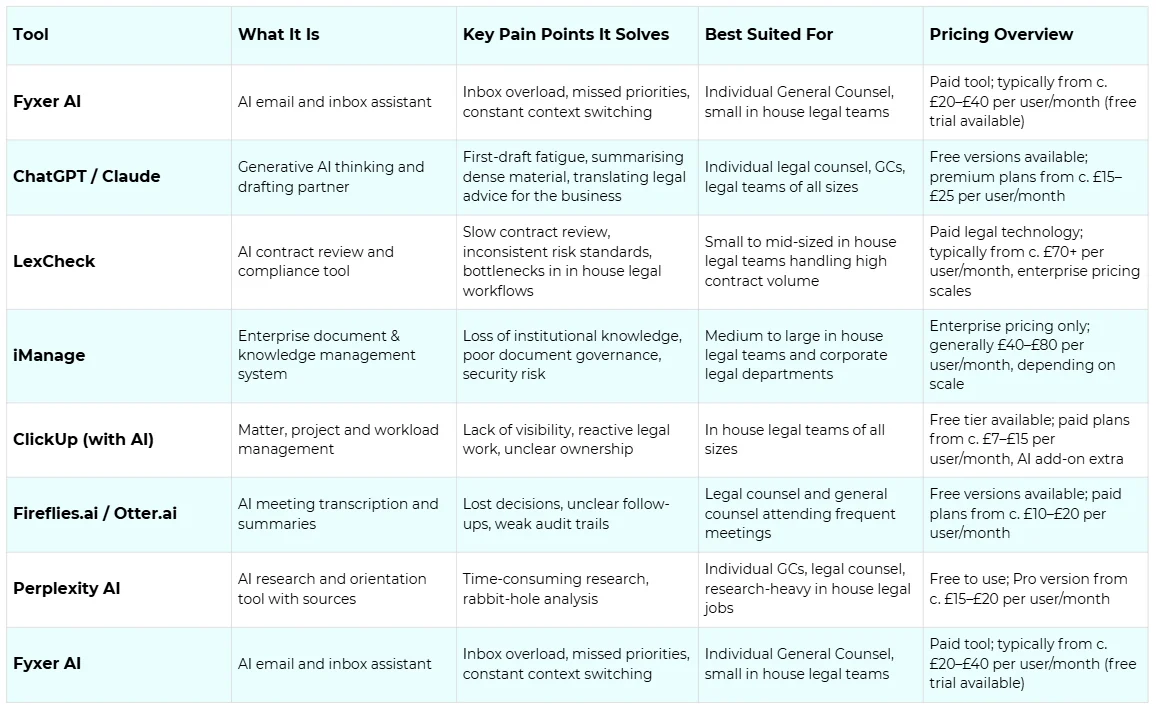
The real wishlist item for General Counsel
Individually, none of these tools are revolutionary. Together, they form something more interesting: an AI toolkit designed for legal leadership, not just legal work.
The modern General Counsel doesn’t need more output. They need fewer unnecessary obstacles between them and good decisions.
And as expectations rise across in house legal jobs, the ability to combine judgment, visibility, and smart legal technology will increasingly define the strongest legal leaders.
So if Santa’s listening in 2025, that’s the ask:
Less noise. More clarity. And AI that genuinely earns its place at the table.
Related Articles:
Related Posts

Privilege, Generative AI & the New Duty of Care
26 Sept, 2025
The Truth About AI In-House Lawyers Need To Know
21 Jul, 2025