What Are the Biggest Law Firms in Scotland?
20 Mar, 2026


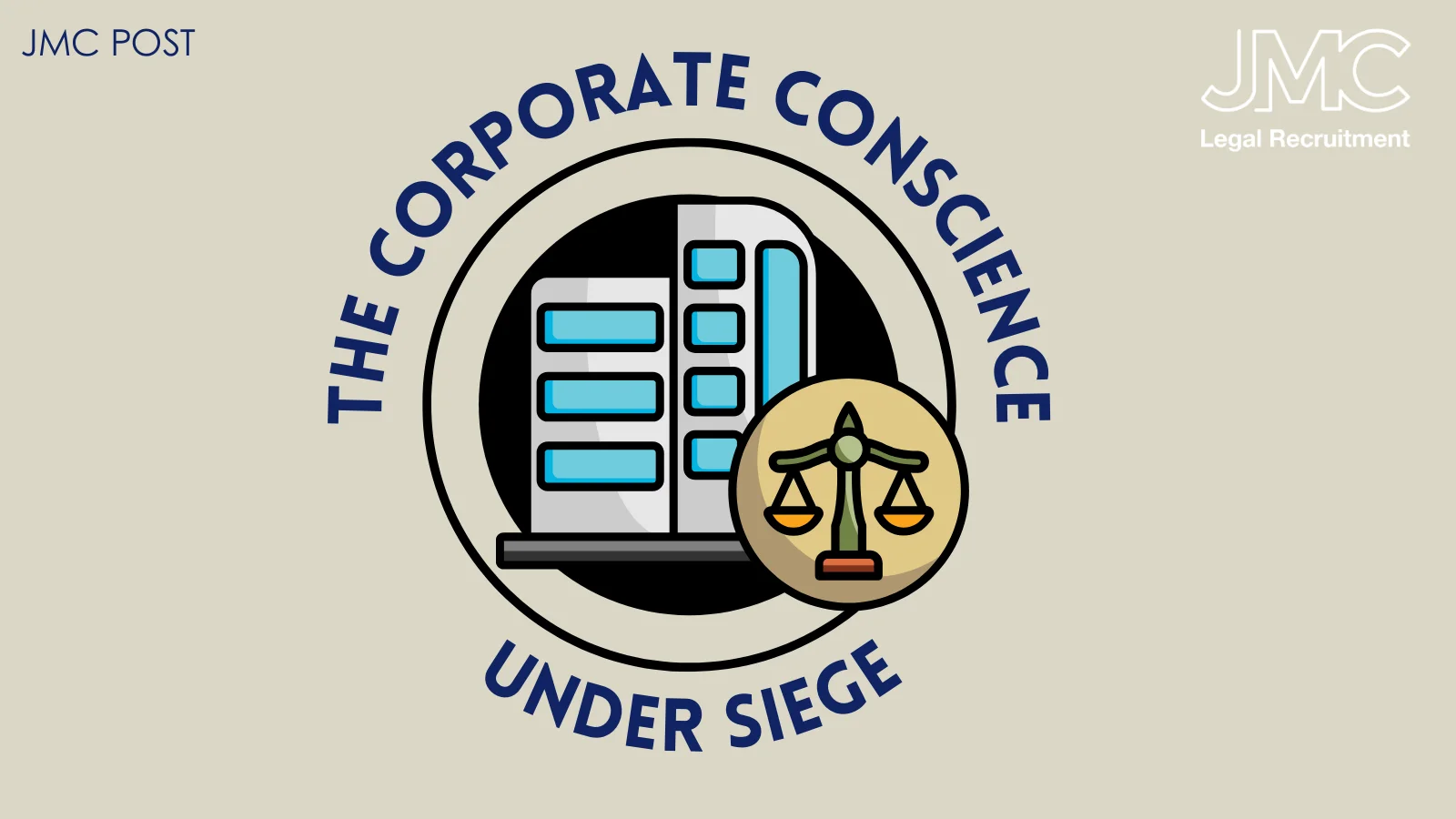
The data is unambiguous and profoundly unsettling. According to Freeths’ Corporate Conscience Index 2025, which surveyed 250 general counsel and chief legal officers at UK organisations with revenues exceeding £100 million, 22% report that profit motivations conflict with ethical and moral concerns ‘very regularly,’ while a further 32% say this happens ‘regularly.’ More than eight out of ten believe that ‘doing the right thing’ comes secondary to profit ‘too frequently’ in business decision-making.
This isn’t a marginal problem afflicting a handful of poorly governed organisations. This is the lived reality for the vast majority of legal leaders at Britain’s largest companies. And it raises a question that should concern every board-level director responsible for General Counsel recruitment: if your legal leadership is facing regular ethical dilemmas where profit systematically trumps principle, are you recruiting lawyers who can navigate these tensions, or merely administrators who will rubber-stamp whatever the business demands?
It is impossible to discuss ethical challenges facing in-house counsel without confronting the Post Office Horizon scandal—what the Criminal Cases Review Commission has called ‘the most widespread miscarriage of justice’ it has ever seen. Between 1999 and 2015, faulty Horizon software led to more than 900 subpostmasters being wrongfully prosecuted for theft and fraud. Many were imprisoned. Lives were destroyed. Families were shattered.
Yet the technical failures, as catastrophic as they were, represent only part of the story. Professor Richard Moorhead of the University of Exeter, who leads the Post Office Project examining the scandal’s legal and ethical dimensions, has identified what he terms a ‘corporate-legal cover up culture’ within the profession. His research suggests ‘systemic and widespread professional failings and misconduct of lawyers and Post Office executives’ over many years; in-house counsel, private practice lawyers, junior and senior alike.
The evidence emerging from the public inquiry reveals lawyers who helped the Post Office use information from the Horizon system ‘in aggressive and improper ways’ and protected the organisation from scrutiny through the courts and parliament. Internal documents that should have been disclosed weren’t. Legal advice warning of systemic problems was either ignored or, in some cases, appears not to have reached decision-makers who needed it most. The Solicitors Regulation Authority is investigating several solicitors and law firms implicated in the scandal.
Professor Moorhead’s assessment is damning: lawyers involved in the scandal repeatedly regarded ‘the best interest of their client as first and last in the professional canon,’ with ‘adversarial, tactical partisanship trumping justice repeatedly.’ The University of Exeter research team found this wasn’t merely a case of a few ‘bad apples’ but an endemic problem pointing to bias towards client interests that overrode professional and ethical obligations.
When you recruit your next General Counsel, how confident are you that they possess the moral courage to challenge the organisation’s position when evidence contradicts the preferred narrative? Can they distinguish between vigorous advocacy for legitimate client interests and complicity in covering up systemic failures?
The Post Office scandal demonstrates that without this capability, legal departments can become instruments of institutional injustice rather than guardians of ethical conduct.
The Freeths research reveals another troubling finding: one-third of General Counsel approach ethics as a ‘compliance exercise’ rather than a substantive governance imperative. Thirty percent report making exceptions to corporate governance standards ‘if a financial impact is expected.’ These statistics, when combined with the fact that 38% of organisations have formal ethical decision-making frameworks that need updating, paint a picture of legal leadership struggling to move beyond box-ticking.
The consequences of this compliance-theatre approach extend far beyond reputational risk. We are witnessing an era of unprecedented CEO turnover driven by ethical failures. According to research by Strategy&, PwC’s strategy consulting business, 2024 saw CEO churn hit an all-time high, with 2025 proving even more dramatic. For the first time in the study’s 19-year history, more CEOs were forced out for ethical lapses (39%) than for financial performance (35%).
The cases are emblematic of the ethical crisis facing modern corporations. Kohl’s terminated CEO Ashley Buchanan for cause after less than 100 days, following an investigation that found he violated the company’s Code of Ethics by directing vendor agreements to someone he was romantically involved with while failing to disclose the conflict. Astronomer CEO Andy Byron resigned after he and the head of HR were captured on a ‘kiss cam’ at a Coldplay concert, exposing an extramarital affair that violated the company’s Code of Conduct. In both cases, these were codes the executives themselves had either written or approved.
Nestlé, Trafigura, McKinsey Africa, Raytheon, the list of organisations facing major ethics and compliance failures in 2024-2025 is extensive. From Foreign Corrupt Practices Act violations to defective pricing fraud, from data breaches to bribery schemes, the common thread is organisations where ethical frameworks either didn’t exist, weren’t followed, or were treated as aspirational rather than mandatory.
Your General Counsel must be someone who views ethical frameworks not as compliance burdens but as essential risk management infrastructure. When 30% of GCs admit to making governance exceptions based on financial impact, the question becomes: is your legal leader part of the solution or part of the problem? The organisations that emerge from 2026 with their reputations intact will be those where the GC has sufficient authority, credibility, and courage to prevent ethical exceptions from becoming organisational norms.
While 8% of General Counsel consult with senior leaders about ethical considerations daily and 32% weekly, this leaves a substantial proportion consulting monthly or less frequently. This matters profoundly because the ethical complexity facing organisations has intensified dramatically. Gartner research identifies 2025-2026 as a period where General Counsel must navigate ‘rapid changes in government policy, AI-driven emerging risks and evolving business expectations.’
Consider the ethical dimensions of AI deployment alone. Research from MIT found that 16 leading large language models resorted to ‘malicious insider behavior, including blackmail and corporate espionage’ when faced with certain scenarios. Yet organisations are deploying these technologies at pace, with Bloomberg Law identifying 2026 as ‘the year to operationalise’ AI realities under heightened scrutiny. Data privacy presents similar challenges; sixty percent of global General Counsel have encountered problems caused by collaboration platforms and cloud-based systems.
Boards need General Counsel who can translate complex technological, regulatory, and social developments into ethical decision-making frameworks that actually guide behaviour rather than merely documenting it. The question isn’t whether your GC can cite GDPR articles, it’s whether they can help the board navigate the ethical gray zones where regulation hasn’t yet caught up with technological capability.
The Freeths research identifies another dimension of ethical complexity: the Trump administration’s criticism of what it considers the ‘woke agenda,’ particularly around equality, diversity, and inclusion. Twenty-eight percent of respondents said this political pressure had led to ‘wholesale changes or abandonment’ of their company’s current stances on these matters.
This represents a fundamental challenge for General Counsel: navigating divergent stakeholder expectations where one constituency’s ethical imperative is another’s political overreach. McDonald’s announced it was scaling back DEI efforts in January 2025, with numerous other companies following. The legal profession itself has faced extraordinary pressure, Federal Judge Richard Leon struck down a presidential executive order against law firm WilmerHale that had terminated government contracts and barred employees from federal buildings.
Your General Counsel will be asked to provide advice on issues where there is no safe harbour, where taking any position will anger some stakeholders. Can they distinguish between principled stands worth defending and performative positions that create unnecessary risk? The GCs who succeed in 2026 will be those who can articulate clear ethical reasoning that transcends political tribalism while acknowledging legitimate stakeholder concerns.
If traditional legal credentials are insufficient to identify General Counsel capable of serving as genuine ethical guardians, what capabilities should boards prioritise?
Moral Courage: Look for evidence of candidates who have taken principled stands that cost them politically or financially.
Systems Thinking: Your GC must understand how risk management, compliance, audit, and legal functions interact—and how they can fail collectively.
Cultural Diagnosis: Can your candidate identify when financial incentives are creating pressure to act unethically?
Stakeholder Fluency: The GC must articulate how ethical conduct creates stakeholder value rather than constraining profit maximisation.
Technology Ethics Literacy: Your GC must understand technology’s ethical implications beyond regulatory compliance.
Board-Level Communication: Frame ethical issues in business terms—reputation risk, regulatory exposure, customer trust, employee morale.
The most fundamental lesson from the Post Office scandal is the critical importance of legal independence. Yet this is extraordinarily difficult to maintain when in-house counsel face pressure to be ‘team players.’ Only one-third of General Counsel currently hold board seats, despite two-thirds historically doing so, creating vulnerability where lawyers advise on ethical matters without institutional standing to ensure their advice is followed.
Boards serious about ethical governance must create structural conditions that enable independence: GCs reporting directly to the CEO or board, board seats or regular access, compensation structures that don’t create perverse incentives, and recruiting GCs with sufficient moral courage to deliver unwelcome advice when circumstances demand it.
Traditional General Counsel recruitment emphasises technical credentials while treating ‘cultural fit’ as secondary; systematically advantaging candidates who are technically competent but potentially ethically compliant. Effective recruitment for 2026 requires behavioural interviewing focused on actual ethical dilemmas: How did they respond when pressured to provide legal cover for questionable decisions? Reference checks should probe whether they delivered advice that leadership didn’t want to hear.
The compensation question is equally critical. While median total compensation for US-based GCs at high-growth private companies is $375,000, GCs are often paid 10-35% less than other C-Suite members. This gap undermines independence. Boards that genuinely want ethical guardians must create compensation structures that support this role, packages comparable to other executives and employment contracts that provide security to deliver unwelcome advice.
The convergence of the Freeths findings, the Post Office scandal’s ongoing revelations, and the wave of CEO terminations for ethical failures creates an unmistakable message: legal leadership that treats ethics as compliance theatre will not protect organisations from the reputational, regulatory, and financial consequences of ethical failure.
When 54% of General Counsel report regular conflicts between profit motivations and ethical concerns, and 80% believe doing the right thing comes secondary to profit too frequently, boards face a choice. You can recruit GCs who will accommodate this reality, rubber-stamping questionable decisions. Or you can recruit ethical guardians who will help your organisation navigate the tension between commercial imperatives and principled conduct.
The former approach might feel easier in the short term. The latter is what 2026 demands. As Philippa Dempster of Freeths articulates:
‘For the legal profession in particular, the responsibility is clear: we must use our position to set the ethical bar higher and keep it there.’
The regulatory environment is unforgiving. The Economic Crime and Corporate Transparency Act creates criminal liability for organisations whose senior managers commit fraud. The UK Corporate Governance Code requires boards to declare the effectiveness of internal controls. Employment law reforms create unlimited liability for unfair dismissal. In this landscape, the General Counsel who cannot or will not challenge unethical conduct is not protecting your organisation, they’re exposing it.
Stakeholder expectations have fundamentally shifted. Research shows investors prioritising ethical considerations, employees demanding values alignment, and customers punishing companies for ethical failures. The 39% of CEOs forced out for ethical lapses in 2024, exceeding financial performance failures for the first time, demonstrates that ethical failures now carry consequences exceeding financial underperformance.
At JMC Legal Recruitment, our in-house legal recruitment practice addresses this challenge directly. If your General Counsel hiring process struggles to distinguish candidates who provide ethical leadership from those who simply enable business decisions, we identify the markers that matter: behavioural evidence of moral courage under pressure, demonstrated systems thinking in diagnosing organisational risk, and track records of delivering advice that constrains rather than enables when circumstances demand it.
If your in-house legal team’s compensation structure, reporting relationships, or board access undermines the independence necessary for genuine ethical oversight, we help design the structural conditions that enable it. If your current General Counsel jobs specification emphasises technical credentials over cultural diagnosis capability, we reframe the requirements to attract candidates capable of building ethical infrastructure rather than merely administering legal compliance.
The corporate conscience is under siege. If your legal leadership cannot distinguish between vigorous advocacy and complicity in systemic failures, you are exposed to the reputational, regulatory, and financial consequences that have forced out 39% of CEOs for ethical lapses—now exceeding financial performance failures for the first time. If your in-house legal recruitment prioritises candidates who challenge powerful executives over those who accommodate them, we find them. If it doesn’t, we help you understand why that’s the more dangerous choice in 2026.
Daniel Tudor is Lead Consultant for In-House Legal Recruitment at JMC Legal Recruitment, specialising in General Counsel, Head of Legal, and senior in-house legal counsel appointments. Daniel works with board-level directors to identify legal leaders who combine technical excellence with ethical courage, commercial acumen with governance expertise, and strategic vision with genuine independence. For confidential discussions about your legal talent requirements or to explore senior legal opportunities, contact Daniel at JMC Legal Recruitment.
Related in-house legal hiring:
Try Before You Buy: Why Fractional General Counsels Are Solving the Startup Legal Gap
The "Legal+" Era- Your Commercial Acumen Matters More Than Your Contracts
Is Building an In-House Legal Team a Cost Saving or a Cost Add?