Hiring Your First General Counsel in the UK
24 Aug, 2026



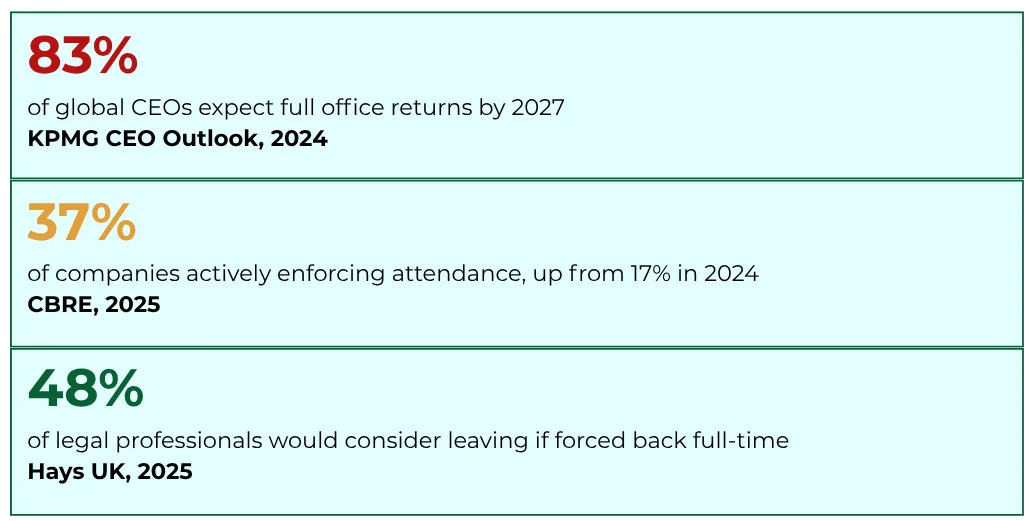
The return-to-office movement has reshaped the employment landscape across every sector and size of business. Amazon, Google and WPP have all tightened attendance requirements over the past eighteen months, and the trend spans industries and business models. Across our own client base, we have seen a consistent shift back towards in-office expectations since 2024, with genuine flexibility increasingly negotiated case by case rather than offered as standard.
The macro data reflects this direction of travel.
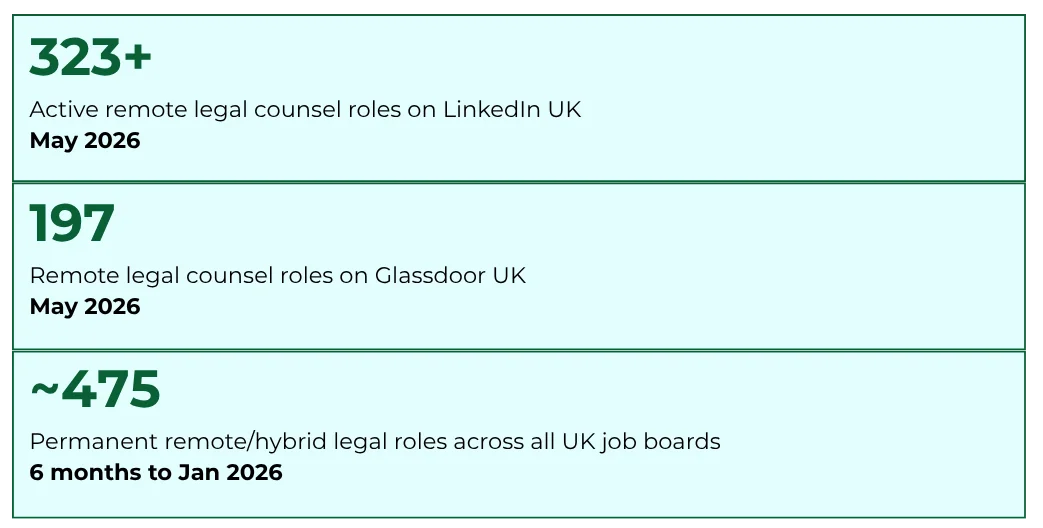
For in-house lawyers, the practical consequence is a pool of genuinely remote roles that is contracting while demand for them has not. Across UK job boards today there are fewer than 500 permanent remote or hybrid legal positions actively listed, a small number relative to the size of the profession. The roles that do appear attract significant interest.
Fewer than 5% of UK jobs are fully remote. For legal roles specifically, the supply is narrower still — which makes understanding exactly where those roles sit more important than ever.
Job board figures move quickly by nature — treat the counts above as indicative of scale as of May 2026 rather than a fixed number.
The employers consistently advertising remote legal counsel positions share one underlying characteristic: their business does not require a legal function to be physically located anywhere in particular. That is structural, not cultural, these employers were remote-friendly before the pandemic, and the broader RTO trend doesn't change that.
Technology and SaaS companies produce the most consistent supply of remote legal roles. Their product is delivered digitally, their teams are spread across multiple countries, and their legal work: commercial contracts, data privacy, IP, technology agreements, regulatory compliance, is all document and advice-based. There is no physical operation that requires a lawyer's on-site presence. Remote legal hiring reflects how these businesses are built, not a concession to candidate preferences.
US-headquartered businesses covering Europe from the UK represent a large subset of these opportunities. An American technology, cybersecurity or life sciences company with a UK legal entity but no established European office needs locally qualified legal resource, and that person will necessarily work remotely. These roles, covering European or EMEA operations, are among the most genuinely remote positions in the market.
Fintech and payments businesses are the second most active category. They tend to be younger organisations with less embedded office culture, and their legal work, FCA and PRA engagement, payments licensing, digital assets, cross-border regulatory compliance, is multi-jurisdictional by nature. European fintechs expanding into the UK, particularly from France, the Netherlands and the Nordics, add a further stream of remote roles for UK-qualified lawyers.
Early-stage businesses from Series A through Series C form a third category that cuts across sectors. A company hiring its first or second in-house lawyer has not yet established the office culture or attendance expectations of a more mature organisation. At this stage, finding the right person typically determines the arrangement, not the other way around.
Remote in-house legal positions are concentrated at a specific level of seniority, in a specific set of practice areas, and they pay accordingly- understanding all three helps focus a search.
Seniority. The 3–7 PQE bracket accounts for the large majority of remote roles. At this level, lawyers have enough experience to operate independently; managing their own workload, advising without escalation, and building working relationships with non-legal stakeholders without team support. Below that bracket, most employers want new in-house lawyers embedded in the team while they develop commercially. Above it, at Head of Legal and General Counsel level, the board and leadership engagement that these roles require makes full remote working uncommon outside very small or highly distributed businesses.
 Approximate distribution based on active UK remote legal counsel roles across major job boards, May 2026
Practice areas. Commercial law dominates: contract negotiation and management, technology and SaaS agreements, data privacy and GDPR compliance, IP licensing. Employment law appears regularly in EMEA-coverage roles. Regulatory and compliance expertise, particularly FCA, payments and digital assets, is in demand in fintech. The common thread is work that is transactional and advisory, with clear inputs and outputs that can be managed independently of a physical location.
Salary. Remote in-house legal roles are concentrated in technology and fintech, sectors that pay above the in-house average. The median salary for remote and hybrid legal roles in the UK currently sits at £65,000 and has risen 18% year-on-year, reflecting the seniority level at which these roles sit and the premium that genuine flexibility now commands. Broader market data suggests remote roles in the UK pay on average 7–8% more than comparable office-based positions, partly because employers offering them tend to be competing for a smaller pool of candidates willing to take on the autonomy they require.
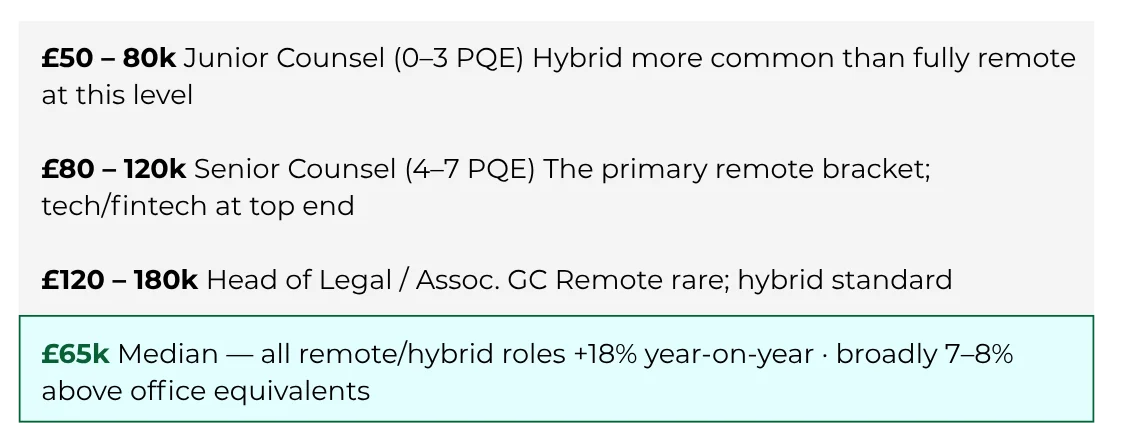 Salary benchmarks — remote in-house legal, UK 2026
The employers making remote in-house legal hires are a specific group with consistent requirements. They are typically operating across multiple jurisdictions, building fast, and hiring a legal function rather than a team member. The candidates who connect with them most effectively are those whose background already reflects that context, not those who have simply added remote availability to their pitch.
Sector experience is the most direct signal. A US technology business launching a UK subsidiary, a European fintech entering the UK market, a SaaS company scaling its commercial function, each has specific and immediate legal requirements. A candidate who has worked on SaaS contracts, data privacy, FCA licensing or digital assets can add value from day one; one who hasn't faces a learning curve these lean businesses rarely have the capacity to absorb. Matching your application to companies whose legal profile already overlaps with your experience is essential in this market.
Cross-border experience is genuinely differentiating. Candidates who have managed external counsel in other jurisdictions, reported to an overseas line manager, or worked for a US or European employer already understand how these businesses actually operate; the pace, the directness, and the expectation that legal acts as a business partner rather than a gatekeeper. That alignment is visible to hiring managers, and it matters more than most candidates realise.
A track record of autonomous working speaks louder than a preference for it. These employers are not hiring someone to join an existing team. They are hiring a standalone legal resource. Prior experience as a sole counsel, covering a region or jurisdiction independently, or managing a practice area without day-to-day supervision signals genuine readiness for that responsibility. Demonstrating that you have operated this way, in practice, not just in principle, is what separates credible candidates in these processes.
How you frame your experience matters. The leadership teams at tech and fintech businesses making these hires are not lawyers. Candidates who describe their work in terms of commercial outcomes, the deals enabled, the risk managed, the decisions they supported, resonate more than those who describe legal process and workload. This applies as much to a CV as it does to a first conversation.
The candidates who succeed in these processes are not those who want remote work. They are those who already look like the lawyer these businesses need.
Yes, but the pool is genuinely small and concentrated in specific sectors. Fully remote roles are most common at US-headquartered tech and fintech businesses covering Europe, and at early-stage companies without an established office culture. Outside those categories, hybrid is far more likely than fully remote.
Most remote roles sit at 3–7 PQE. Below that, employers generally want new in-house lawyers embedded in a team while they develop commercially. Above 8 PQE, board and leadership engagement usually pulls Head of Legal and General Counsel roles back towards in-person or hybrid working.
Generally, yes. Remote roles are concentrated in sectors that already pay above the in-house average, and broader market data suggests remote roles pay around 7–8% more than comparable office-based positions, partly because employers offering genuine flexibility are competing for a smaller pool of candidates.
Yes. At Head of Legal and General Counsel level, the need for board presence and in-person leadership engagement makes fully remote arrangements uncommon outside very small or highly distributed businesses. Hybrid, typically three to four days remote, is the norm at this level even within remote-friendly employers.
If you are an in-house lawyer looking for remote or hybrid opportunities and would find a conversation about what is currently available useful, we are happy to talk.
Related Article:
How to Read an In House Legal Job Spec
Is Building an In-House Legal Team a Cost Saving or a Cost Add?