From Senior Counsel to General Counsel
01 Apr, 2026



Every week, without exception, I receive calls from law graduates across the UK who are bewildered, deflated, and increasingly desperate.
They have applied to twenty firms. Thirty firms. Some have applied to fifty. They have had almost no responses. When they do hear back, there is no feedback, just a politely worded rejection, if anything at all. They are beginning to wonder whether something is fundamentally wrong with them, whether law was the wrong choice, whether the uk legal jobs market is simply closed.
In almost every case, the problem is not them. The problem is their CV.
Not because they are bad candidates. Many of the graduates who contact me are genuinely impressive people, articulate, motivated, commercially curious, and well-suited to a legal career. The problem is that nobody ever taught them how to translate those qualities onto paper. They were handed a degree, pointed toward the job market, and left to figure out one of the most consequential professional documents they will ever produce without a single hour of meaningful guidance.
I have been placing legal professionals for long enough to know that this is not an individual failure. It is a systemic one. And it is costing graduates months of their careers, significant mental health strain, and in some cases, the profession entirely.
This piece is my attempt to say plainly what I say in those calls every week, because every graduate deserves to hear it before they send their first application, not after they have already sent fifty.
Before answering this, it is worth understanding what a CV is actually for, because this is where most graduates' thinking goes wrong from the very beginning.
A CV is not a record of your life. It is not an academic transcript. It is not a list of everything you have ever done in roughly chronological order. It is a sales document with a single, time-pressured audience: a partner, associate, or HR director who will spend between thirty and sixty seconds on it before deciding whether to read further or move on.
That is the reality. Thirty seconds. In a market where firms receive hundreds of applications for every position, the person reviewing your CV is not looking for a reason to call you. They are looking for a reason not to. The job of your CV is to survive that first thirty seconds and earn the next thirty.
They lead with the wrong things. The majority of graduate CVs I receive open with a personal statement that reads like a UCAS application: "I am a highly motivated and hardworking individual with a passion for law who is seeking a challenging role in a dynamic firm." This tells a partner nothing. It sounds like every other candidate. It occupies prime real estate at the top of the document with content that actively undermines confidence in the candidate.
They treat academic achievement as the main event. A 2:1 from a good university is a baseline. It is the entry ticket to the conversation, not a differentiator. Yet many graduate CVs devote enormous space to module grades, dissertation topics, and academic prizes, while burying the work experience, the thing a hiring partner actually wants to know about, on page two.
They describe roles rather than demonstrating impact. "I undertook a vacation scheme at [firm name] where I worked in the corporate department." Versus: "During a vacation scheme at [firm name], I assisted the corporate team on two live transactions, drafted client correspondence, and attended a completion meeting." Both describe the same experience. Only one of them tells a partner what you actually did and what you are capable of.
They are written for the candidate, not the reader. The instinct when writing a CV is to include everything, every qualification, every role, every responsibility, every society membership, as evidence of breadth. But a CV that tries to say everything ends up saying nothing. The reader is not forming a complete picture of you. They are scanning for specific signals. If those signals are not immediately legible, you have lost them.
They are generic. The same CV sent to fifty firms is a losing strategy, and experienced hiring teams can tell. A CV that has been tailored to the practice area, firm type, and specific role it is targeting, that speaks the language of that firm and reflects genuine knowledge of what they do, is immediately distinguishable from one that has not. Most graduates never do this, because nobody ever explained that it was necessary.
This is one of the questions I am asked most frequently, and it is worth addressing directly because the silence compounds the problem enormously.
Law firms, particularly large ones, do not routinely provide feedback on unsuccessful applications for entirely practical reasons. When you receive five hundred applications for eight training contract places, the resource required to provide meaningful individual feedback to four hundred and ninety-two people does not exist. Some firms use automated rejection systems that send a standardised response within minutes of the application being reviewed. Others simply do not reply at all.
For a graduate who has spent hours on an application, this silence is devastating. And its effect on behaviour is almost always counterproductive. Without feedback, candidates cannot learn. Without learning, they repeat the same mistakes across their next application, and the one after that. The silence creates a cycle of rejection that feels increasingly personal and increasingly hopeless, even when the underlying issue is something entirely fixable.
What graduates should understand, and what no one tells them, is that the absence of feedback is not a verdict on their potential. It is a function of volume. The correct response to repeated rejection without feedback is not to apply to more firms in the same way. It is to stop, get an honest external assessment of your application materials, and change your approach.
This is the question I hear most often from recent law graduates, and it is grounded in a misconception that I want to address head-on.
The assumption behind the question is that a lack of formal legal work experience means there is nothing compelling to put on a CV. That assumption is wrong. And it leads graduates to produce what I think of as the clinical CV, a technically correct document that lists their degree, their grades, and perhaps a part-time job, and communicates almost nothing about who the person actually is or what they are capable of.
The truth is that legal employers at the early-career stage are not primarily hiring for what you have already done. They are hiring for what you demonstrate you are capable of. Those are different things, and the difference matters enormously for how you approach a CV with limited experience.
Consider what you have actually done in the course of your education and life to this point. Have you held any kind of leadership role, in a student society, a sports team, a part-time job? Have you managed other people, even informally? Have you dealt with difficult situations that required judgment, composure, or communication under pressure? Have you done anything entrepreneurial, built something, organised something, sold something? Have you worked in any customer-facing role (valuable experience for both private practice and in house legal jobs) that required you to manage relationships, handle complaints, or represent an organisation to the public?
Every one of these experiences is relevant. Not because it demonstrates legal knowledge, but because it demonstrates the qualities that make a good lawyer, judgement, communication, resilience, commercial instinct, and the ability to perform under pressure. The failure of most graduate CVs is not that the experiences are absent. It is that they are either not included, or included in a way that strips them of their meaning.
"Worked part-time at a retail company" tells a partner nothing. "Managed a team of four part-time staff as shift supervisor at [company], responsible for customer escalations and daily cash reconciliation" tells them quite a lot. The experience is the same. The framing is entirely different.
This is a skill. It is the skill of translating lived experience into the commercial language that legal employers respond to. And it is a skill that law schools, with very few exceptions, simply do not teach.
The advice to "tailor your CV to each application" is one of the most repeated and least explained pieces of careers guidance in existence. Graduates hear it constantly. Almost none of them know what it means in practice.
Tailoring is not changing your name at the top and the firm's name in the cover letter. That is not tailoring. That is a mail merge. Genuine tailoring means making specific, deliberate choices about what to emphasise, what to de-emphasise, and how to frame your experience in light of what a specific firm or role is looking for.
A firm's website, their recent work, the practice area you are applying to, the values and culture they publicly espouse, all of this is intelligence that should be informing the shape and language of your CV. A candidate applying for training contracts at a corporate boutique should be surfacing every piece of commercial, transactional, or business-facing experience they have. A candidate applying to a litigation practice should be foregrounding analytical ability, attention to detail, and any experience of dispute, negotiation, or advocacy. A candidate targeting in house legal jobs should be emphasising business acumen, cross-functional collaboration, and any experience working directly with commercial stakeholders. A candidate applying to a legal technology team should be demonstrating not just legal knowledge but genuine engagement with technology and innovation.
None of this requires fabricating experience. It requires reading the room and presenting your authentic experience in the way most legible to that particular audience. Every experienced recruiter does this as a matter of course when preparing a candidate for submission. Most graduates have never been shown how to do it for themselves.
Most graduates treat the cover letter as an obligation. A box to tick. A slightly expanded version of their personal statement, dutifully submitted because the application portal requires it.
This is a significant missed opportunity.
The cover letter, when written well, is the only part of an application that speaks directly to a specific firm about why you specifically want to work there. It is where you can demonstrate the research, the genuine interest, and the commercial awareness that a CV alone cannot convey. A partner who reads a cover letter that references a recent deal the firm advised on, makes an intelligent observation about the practice area, and connects that clearly to the candidate's own background and ambitions will remember that candidate.
The cover letter that says "I am writing to apply for a training contract position at your esteemed firm, as I believe my skills and experience make me an excellent candidate" is forgotten before it has been finished.
Here too, the investment of time is asymmetrical. Writing ten genuinely good, specifically targeted cover letters will outperform sending fifty generic ones, in terms of responses received, quality of firms engaged, and the candidate's own sense of agency and confidence in the process.
But again: this requires knowing how. And knowing how requires being taught.
Before submitting any application, work through this checklist. If you answer no to any of these questions, stop and fix it before pressing send.
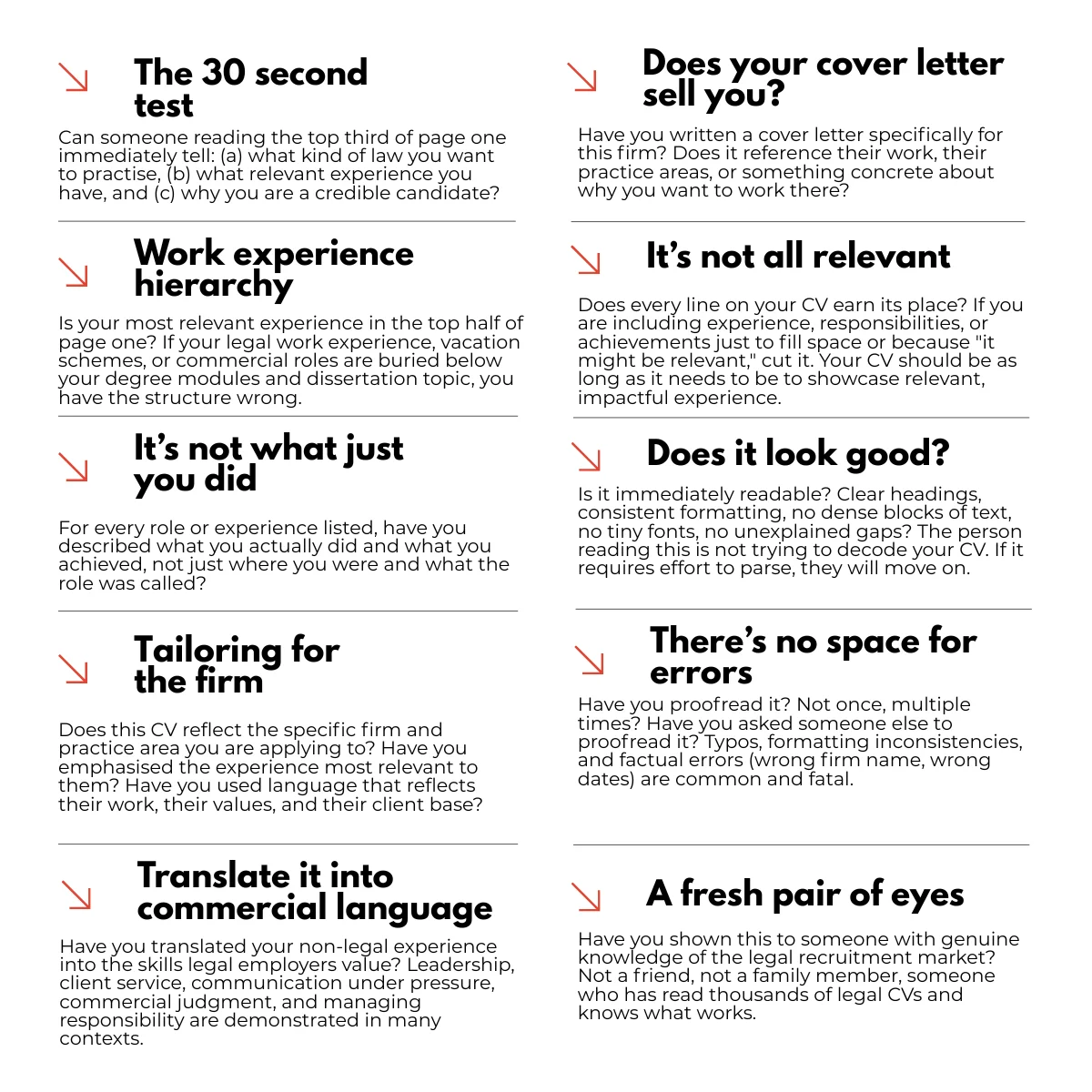
Can someone reading the top third of page one immediately tell: (a) what kind of law you want to practise, (b) what relevant experience you have, and (c) why you are a credible candidate? If your personal statement, academic grades, or irrelevant early experience occupies this space, you have already lost them.
Is your most relevant experience in the top half of page one? If your legal work experience, vacation schemes, or commercial roles are buried below your degree modules and dissertation topic, you have the structure wrong. Work experience comes first. Academic credentials come second.
For every role or experience listed, have you described what you actually did and what you achieved, not just where you were and what the role was called? "Assisted on two live M&A transactions and drafted client correspondence" beats "worked in the corporate department" every time.
Does this CV reflect the specific firm and practice area you are applying to? Have you emphasised the experience most relevant to them? Have you used language that reflects their work, their values, and their client base? If you are sending the same CV to a City corporate firm and a high-street criminal practice, you are doing it wrong.
Have you translated your non-legal experience into the skills legal employers value? Leadership, client service, communication under pressure, commercial judgment, and managing responsibility are demonstrated in many contexts. If you worked in retail, hospitality, customer service, or any client-facing role, you should be surfacing these skills explicitly.
Have you written a cover letter specifically for this firm? Does it reference their work, their practice areas, or something concrete about why you want to work there? If your cover letter could be sent to any firm by changing the name at the top, it is not doing its job.
Does every line on your CV earn its place? If you are including experience, responsibilities, or achievements just to fill space or because "it might be relevant," cut it. Your CV should be as long as it needs to be to showcase relevant, impactful experience. Two pages of substance beats four pages of padding, but four pages of genuinely relevant, well-described experience beats two pages of thin content. No waffle, no filler, no generic responsibility lists.
Is it immediately readable? Clear headings, consistent formatting, no dense blocks of text, no tiny fonts, no unexplained gaps? The person reading this is not trying to decode your CV. If it requires effort to parse, they will move on.
Have you proofread it? Not once, multiple times? Have you asked someone else to proofread it? Typos, formatting inconsistencies, and factual errors (wrong firm name, wrong dates) are common and fatal. Do not let a single spelling mistake cost you an interview.
Have you shown this to someone with genuine knowledge of the legal recruitment market? Not a friend, not a family member, someone who has read thousands of legal CVs and knows what works. If the answer is no, and you have applied to more than ten firms without a response, this is the step you are missing.
When I review a graduate CV, I can typically identify two or three specific, fixable problems within minutes. The personal statement working against them. The way their most relevant experience is buried or misdescribed. The generic language that makes them indistinguishable from every other candidate. The missed opportunity in a cover letter that could have differentiated them entirely.
These are not small things. In a market where the difference between an interview and a rejection can be a single sentence on page one, they are everything.
The transformation in outcomes when these issues are addressed is consistently dramatic. Not because the candidate has changed, but because the document finally reflects who they actually are.
This is why external professional assessment matters. Not as a last resort after fifty failed applications, but early. An experienced recruiter or careers adviser with genuine market knowledge can identify what is not working, explain why it is not working, and show you how to fix it. The service costs nothing. The guidance is honest. The time saved is considerable.
The challenge is knowing who to ask. Not every careers service has current market knowledge. Not every recruiter specialises in graduate placement. The key is finding someone who works with law firms daily, understands what they are looking for at entry level, and has a track record of placing graduates successfully.
I do not think this is complicated. The information graduates need to produce a competitive CV and navigate the legal job market effectively is not secret. It is not proprietary. It is not particularly difficult to convey. It simply requires someone to take the time to convey it, clearly, specifically, and with genuine knowledge of how the market actually works.
At minimum, every law student should graduate knowing the following:
A CV is a sales document, not a record. Its purpose is to earn an interview. Every decision about what to include, where to place it, and how to frame it should be made in service of that purpose.
Legal employers read CVs in thirty to sixty seconds. Structure, formatting, and the hierarchy of information matter as much as the content. The most important signals need to be immediately legible.
Experience does not have to be legal to be relevant. Commercial instinct, leadership, communication, resilience, and client-service skills are demonstrated in many contexts. The job is to translate those experiences into the language that a legal employer recognises and values.
Tailoring is not optional. A genuinely tailored application, CV and cover letter, to ten realistic target firms will produce better outcomes than a generic application to fifty.
Silence is not a verdict. The absence of feedback from rejected applications is a function of volume, not a reflection of the candidate's potential. The correct response is to seek external assessment and change approach, not to apply to more firms in the same way.
If you are reading this while still at university, you have an enormous advantage over the graduates who contact me every week, time.
Use the next months to get some form of legal or commercial experience, however modest. A law clinic. A pro bono project. A vacation scheme application, even if unsuccessful, that forces you to articulate why you want to practise law and in what area. A part-time job that puts you in front of clients or customers. Something, anything, that gives you material to work with.
Start thinking about your CV now, not in the month before graduation. Write a draft. Ask someone with genuine market knowledge to review it. Not a friend, not a family member, someone who has read a thousand legal CVs and knows what makes the difference.
The legal market is competitive. That is not going to change. But competition rewards preparation, and preparation is available to anyone willing to seek it out.
I have met careers advisers at law schools who are excellent, knowledgeable, well-connected, and genuinely invested in their students' outcomes. They exist, and they make a real difference to the students they work with.
But they are not the norm. The norm is a careers service that offers one CV review session per year, distributes generic guidance written for a market that no longer exists, and measures its success by the number of events it holds rather than the outcomes its graduates achieve.
The graduates who contact me every week are not failing because they are inadequate. They are failing because they were not prepared. And the gap between what they needed and what they received is one that universities have both the capability and the responsibility to close.
Until they do, the burden falls on graduates to seek out the guidance they should have received as standard. That guidance exists. It is available. And it makes all the difference between silence and response.
Related Articles
Law Schools vs. The Legal Market