Working in UK Defence Law
17 Mar, 2026


If you're studying law, applying for training contracts, or trying to work out what to call yourself, you've probably asked this question: what's the difference between a lawyer and a solicitor?
The short answer is that a solicitor is a lawyer, but not every lawyer is a solicitor. The longer answer involves understanding how legal qualifications work in the UK, what the terms actually mean, and why the distinction matters when you're looking for work.
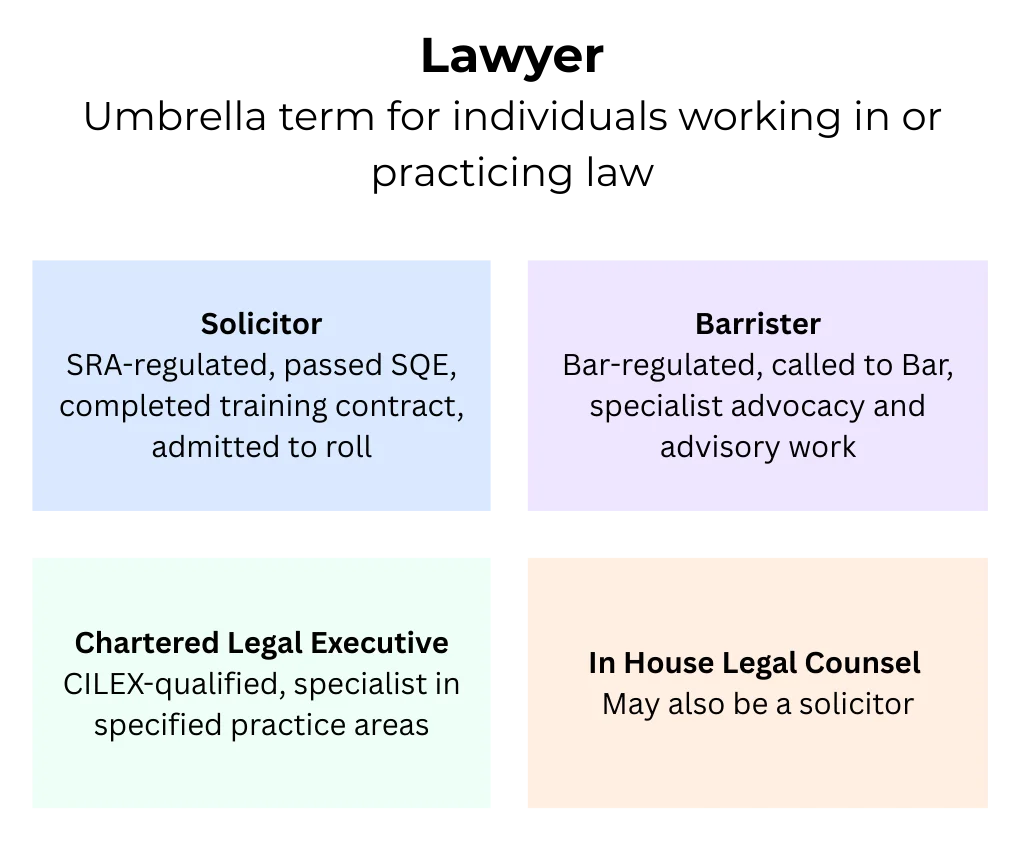
A lawyer is anyone who works in or practices law. That's it. There's no specific qualification attached to the term, no regulatory body that governs it, and no legal protection around who can use it.
In the UK, the word "lawyer" functions as an umbrella term. It covers solicitors, barristers, chartered legal executives, paralegals, legal advisers, in-house counsel, and anyone else working in a legal capacity. You could be a paralegal with no formal qualifications and still accurately describe yourself as working as a lawyer. You could be general counsel at a FTSE 100 company without being a qualified solicitor and still be a lawyer.
The term originates from American legal terminology, where "lawyer" is the standard catch-all for anyone licensed to practice law. In the UK, we've historically been more specific about job titles, but "lawyer" has become widely used in recruitment, job descriptions, and everyday conversation because it's simpler than listing out every possible role.
A solicitor is a specific, regulated legal qualification in England and Wales. To call yourself a solicitor, you must:
Once you're admitted, you can practice law in private practice law firms, work as an in-house solicitor for a company, or move into other legal roles. The title "solicitor" confirms you've met a recognised standard of qualification and are subject to professional conduct rules.
Solicitors handle a wide range of legal work: property transactions, corporate deals, employment disputes, wills and probate, litigation, and more. Most client-facing legal work in law firms is carried out by solicitors.
Scotland has its own system. Scottish solicitors are regulated by the Law Society of Scotland and follow a different qualification route, though the role is broadly equivalent.
The difference is about qualification and regulation.
Solicitor: A regulated professional qualification. You've passed specific exams, completed supervised training, and are held to professional standards by the SRA. It's a protected title. If you call yourself a solicitor without being qualified, you're breaking the law.
Lawyer: A general term with no formal qualification attached. It's useful shorthand, but it doesn't tell you anything about someone's qualifications, their right to practice, or what kind of legal work they do.
In recruitment terms, when a firm advertises a "lawyer" role, they usually mean a qualified solicitor. When someone says "I work as a lawyer," they might be a solicitor, a paralegal, a legal adviser, or in-house counsel. Context matters.
When people ask about the "three types of lawyers," they're usually referring to the three main regulated legal professions in England and Wales:
Regulated by the Solicitors Regulation Authority (SRA). Solicitors typically work in law firms or as in-house counsel. They advise clients, draft legal documents, handle transactions, and prepare cases. Some solicitors also have rights of audience in court, though this isn't automatic.
Regulated by the Bar Standards Board (BSB). Barristers are specialist advocates and advisers. Most of their work involves representing clients in court, providing specialist legal opinions, and advising on complex points of law. Barristers are typically instructed by solicitors rather than directly by clients, though this is changing with the growth of direct access work.
Barristers complete the Bar Professional Training Course (BPTC) and pupillage before being called to the Bar. The qualification route is completely separate from the solicitor route, though some people transfer between the two professions.
Regulated by the Chartered Institute of Legal Executives (CILEx). Chartered Legal Executives are qualified lawyers who specialise in a particular area of law. They often start their careers as paralegals and qualify through a combination of exams and workplace experience. Legal Executives have the same rights as solicitors in their area of expertise and can progress to become partners in law firms or move into other senior legal roles.
Lawyers employed by a company to handle its legal affairs. Many are qualified solicitors or barristers, but not all. The title "General Counsel" or "Legal Director" doesn't automatically mean someone is SRA-regulated.
Beyond these three regulated professions, there are plenty of other legal roles that fall under the "lawyer" umbrella:
Paralegals: Provide legal support to solicitors and barristers. No formal qualification is required to work as a paralegal, though many have law degrees or specialist paralegal qualifications.
Legal advisers: Often work in-house for companies, government departments, or charities. Some are qualified solicitors, others aren't.
Legal consultants: May or may not hold formal qualifications. The term covers a wide range of advisory roles.
The route to becoming a solicitor has changed significantly in recent years with the introduction of the SQE. The traditional route (law degree, Legal Practice Course, training contract) has been replaced by a more flexible system.
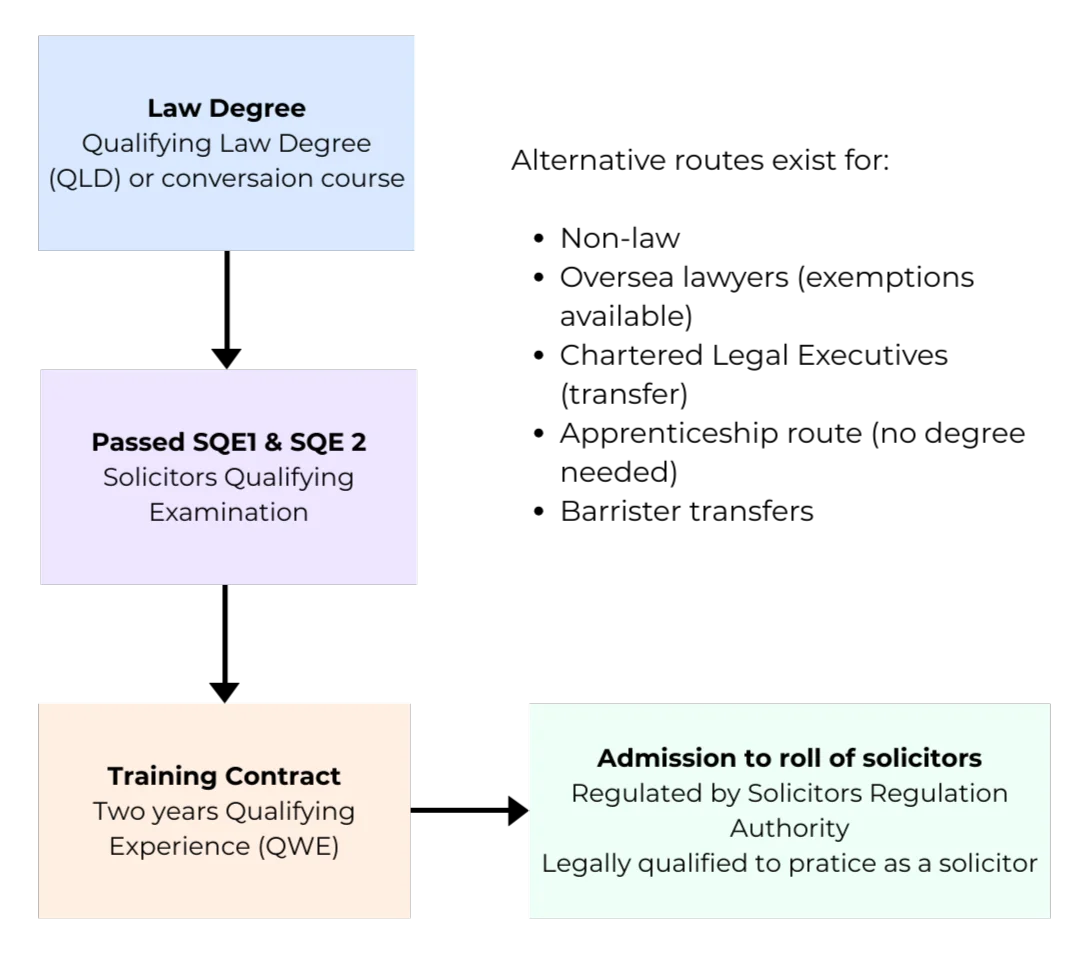
The modern route involves:
For more detail on alternative routes, including overseas qualifications and exemptions, see our guide for overseas lawyers entering the UK market.
Yes, particularly when you're applying for jobs or describing your qualifications.
If a firm advertises a "solicitor" role, they're looking for someone who is qualified or in the process of qualifying. If they advertise a "lawyer" or "legal adviser" role, the requirements might be different. You need to read the job description carefully.
When networking or introducing yourself, being specific helps. "I'm a newly qualified solicitor" is clearer than "I'm a lawyer." The former tells people exactly where you are in your career. The latter could mean anything.
For clients, the distinction matters too. A solicitor has professional indemnity insurance, is regulated by the SRA, and is bound by a code of conduct. A "lawyer" who isn't a qualified solicitor may not have those protections.
If you're a qualified solicitor, you can call yourself a solicitor or a lawyer. Both are accurate.
If you're a paralegal, legal assistant, or working in a legal role without formal qualification, you're a lawyer (in the broad sense), but you're not a solicitor. Calling yourself a solicitor when you're not is illegal.
If you're a law student or graduate, you're not yet a lawyer in the professional sense, though you're certainly studying to become one. Once you start your training contract or QWE, you're typically called a trainee solicitor.
The safest approach is to use your actual job title. If you're a paralegal, say you're a paralegal. If you're a trainee, say you're a trainee. If you're a qualified solicitor, you've earned the right to use that title.
Understanding the difference helps you navigate the job market more effectively.
When you're searching for roles, look for specific job titles rather than just "lawyer." Search for "trainee solicitor," "paralegal," "legal assistant," "in-house counsel," or whatever role matches your qualifications and experience.
When applying, be clear about your status. If you're SQE-qualified but haven't completed your QWE, say that. If you're a paralegal with five years' experience, make that obvious. Recruiters and hiring managers need to know exactly what you bring.
If you're international and qualified overseas, the rules around recognition vary. Some jurisdictions have exemptions or transfer arrangements. Check the SRA's guidance or speak to a recruitment consultant who specialises in placing overseas lawyers.
At JMC Legal, we work with candidates at every stage of their legal career, from paralegals to partners. If you're unsure how to position yourself or what roles to apply for, get in touch. We can help you work out your next move.
A solicitor is a type of lawyer, but the terms aren't interchangeable. "Lawyer" is a broad term covering anyone working in law. "Solicitor" is a specific regulated qualification. All solicitors are lawyers, but not all lawyers are solicitors. For example, paralegals, barristers, and legal advisers are all lawyers, but they're not solicitors.
This question doesn't quite work because "lawyer" isn't a qualification. A solicitor has a specific set of qualifications (SQE, QWE, admission to the roll) and is regulated by the SRA. A "lawyer" might be a solicitor, a barrister, a chartered legal executive, or someone working in law without formal qualifications. The term "lawyer" alone doesn't tell you about someone's qualifications. If you're comparing a solicitor to a barrister or chartered legal executive, they're differently qualified, not more or less qualified. Each has a distinct training route and regulatory framework.
In England and Wales, the three main regulated legal professions are solicitors (regulated by the SRA), barristers (regulated by the Bar Standards Board), and chartered legal executives (regulated by CILEx). Each follows a different qualification route and typically specialises in different kinds of work. Solicitors handle transactions, advisory work, and some advocacy. Barristers focus on specialist advocacy and advisory work. Chartered Legal Executives specialise in particular practice areas and often progress from paralegal roles.
Related resources:
Looking for your next legal role? Whether you're a newly qualified solicitor, an experienced lawyer, or a paralegal ready to take the next step, we can help. Get in touch with the JMC Legal team.