Remote Working Policies at London's Top Law Firms
04 Jun, 2026




London’s legal market is holding steady, but hiring isn’t as straightforward as it looks.
Demand is still there, but increasingly concentrated. And that’s starting to change who actually benefits from it.
Most of the activity is sitting at mid to senior level, where firms are focusing on a narrower group of experienced lawyers and stretching the salary to secure them. Further down, opportunities are tighter than they appear, and even strong junior candidates are finding fewer openings.
That imbalance is starting to reshape hiring trends across the market.
At the top end of the market, a small group of firms is setting the pace.
In areas like corporate, M&A, leveraged finance and funds, US firms alongside Magic and Silver Circle firms are pushing pay beyond traditional benchmarks, forcing the rest of the market to respond.
That pull is changing behaviour. Law firms currently hiring in London are increasingly focused on a narrower group of experienced candidates, forcing constant reassessment of how they can compete.
The impact is most visible in the mid-market. Movement between similar firms has slowed, leaving fewer opportunities for lawyers who would previously have relied on lateral moves to progress. For many, that means fewer options at the same level – and more pressure to either stay put or move up.
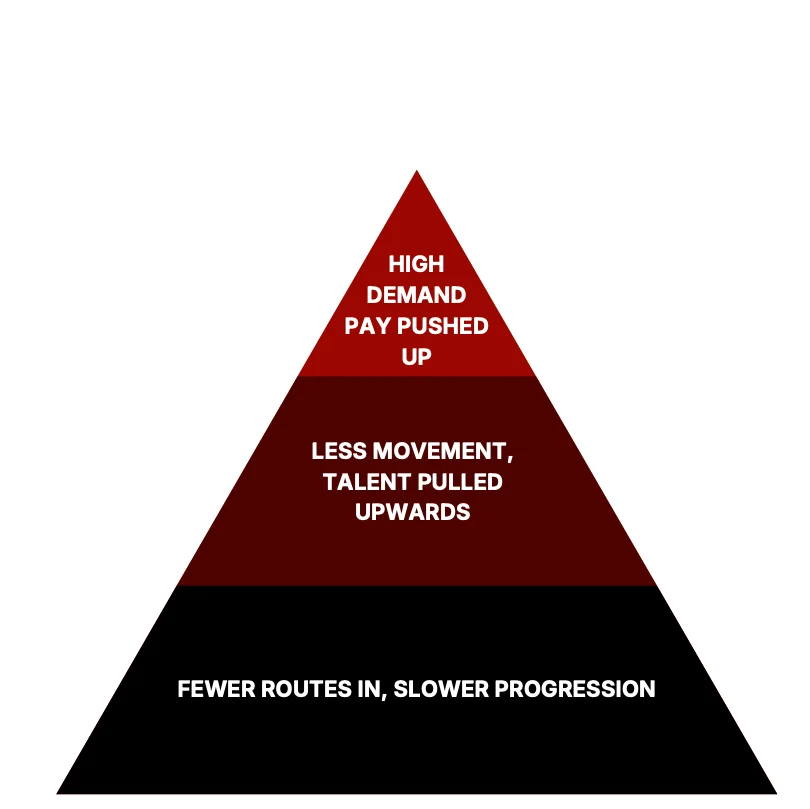
A large part of what’s driving this sits at the top end of the market.
At 6+ PQE, the salary gap is wide enough to change behaviour. Lawyers who might previously have moved between similar firms are now moving into higher-paying roles, often at US firms, where the salary uplift is hard to ignore.
You start to see it in how people talk about their options. Moves that once felt lateral now come with a clear trade-off — higher pay on one side, intensity on the other.
It’s becoming a familiar cycle. Lawyers make the move, stay for a few years, then reassess once the reality of the role starts to settle in. Some return to the mid-market with stronger profiles. Others don’t.
Either way, the effect is the same. Talent isn’t circulating in the same way – it’s being pulled towards the top end.
That pressure is also widening the search.
Firms that might not have looked beyond the UK-qualified pool a few years ago are now actively hiring from markets like Australia, New Zealand and South Africa. Not out of preference, but because the depth of talent locally isn’t enough to meet demand.
The pressure further up the market doesn’t stay there.
At junior level, the impact is less visible, but harder to navigate. At NQ to 2 PQE, the London legal jobs market remains tight. Roles at that level remain limited, and where opportunities do exist, they tend to be more specialised.
You start to see the effect in timing. Lawyers qualifying from top firms aren’t moving as quickly as they might have expected. Some are taking interim roles. Others are stepping in-house earlier than planned, not always by choice.
Part of it comes down to how firms are hiring. When partners are under pressure on time and budget, they tend to favour experience. That shifts demand upwards, leaving junior lawyers caught in the middle – qualified, but not yet experienced enough to meet what firms are asking for.
There’s still opportunity, but it’s narrower than it looks. And for many, progression is less predictable than it once was.
This leaves a market that looks strong from the outside, but feels more selective in practice.
Demand hasn’t disappeared, but it’s sitting in a narrower part of the market – and not everyone is benefiting from it.
For lawyers, that makes decisions harder. Moves come with clearer trade-offs, and timing matters more than it used to.
For firms, it raises the bar. Competing on salary alone isn’t always enough, but neither is standing still. Positioning, structure and long-term planning are starting to matter more than incremental hires.
None of this is a short-term shift. It’s a reflection of how the market is now behaving.
London hasn’t slowed down. It’s just become harder to access.
For more on London’s legal recruitment market and a similar insight on Manchester’s market read these: