Hiring Your First General Counsel in the UK
24 Aug, 2026




The large majority of in-house legal roles are non-contentious. Commercial contracts, corporate governance, regulatory advice and data protection make up most of a typical legal team's work. When disputes arise, they are usually sent straight to external counsel. Contentious in-house roles do exist, but they form a smaller and more concentrated market, clustered in particular sectors and business models.
That concentration shapes hiring. The talent pool is narrower than for a typical commercial counsel hire, and the right profile depends heavily on why the business needs a litigator internally in the first place. The cost case also has to stack up for the finance and operations leaders who sign off the headcount. This piece covers both: how to define and fill the role, and how to build the business case for it.
The decision to hire an internal litigator usually rests on one of three drivers, and the driver tends to determine what kind of role it becomes.
Volume: some businesses generate a steady flow of claims as part of normal operations, including insurers, lenders, housing providers and utilities. Handling every matter externally becomes expensive. An internal lawyer can triage, resolve the straightforward cases and reserve external spend for the matters that justify it.
Value: other businesses face fewer disputes, but each carries significant financial or reputational exposure. Here the internal role centres on strategy: coordinating external firms, shaping settlement decisions and translating litigation risk for the board.
Cost control: pressure on external legal spend is a recurring theme. In Shoosmiths' survey of UK in-house lawyers, General Counsel responding to rising litigation costs said they would consider third-party litigation funding (31%), restrict their cross-jurisdictional reach (34%) and handle more disputes in-house (37%), as reported by Legal Futures.
The broader risk environment adds weight to all three. According to CMS data reported by Legal Futures, the cumulative value of UK class actions has passed £151bn, up almost £17bn on 2024, with actions against big tech companies leading the way. Clifford Chance notes that Big Tech companies continue to be a key target of collective actions in the Competition Appeal Tribunal, and water and sewerage companies now face environmental collective actions there over alleged sewage discharges. For businesses with consumer-facing models, or market positions that draw scrutiny, litigation is becoming a standing risk rather than an occasional event, and that changes the case for internal capability.
For finance and operations leaders, the question is whether an internal hire reduces total disputes spend, or adds cost without displacing external work. The answer depends on the shape of the role, where it is based and the volume of matters it can absorb.
| PQE | Typical Role Shape | In-house litigation: banking, FS and professional services | In-house litigation: insurance | General in-house, South West and North West (bonus) |
2–4 years | Case manager | £110k–£130k | £115k–£125k | £60k–£95k (5–20%) |
4–6 years | Case manager or hybrid | £130k–£150k | £125k–£140k | £70k–£95k (5–25%) |
6–8 years | Hybrid or senior counsel | £150k–£170k | £140k–£150k | £80k–£110k (10–30%) |
8–10+ years | Litigation lead | £170k–£190k | £150k–£190k | £90k–£125k (10–30%) |
Head of Legal / Legal Director | Litigation lead (senior) | £190k+ | £190k+ | £120k+ (10–50%) |
Base salaries, with typical bonus ranges in brackets. Source: published 2025–26 in-house legal salary guides. Litigation figures are UK-wide for the sectors shown; regional figures cover general in-house roles.
Sector moves the number as much as seniority. A litigator in a bank or insurer will typically cost more than the same PQE in a regional commercial business. Published guides put insurance in-house lawyers with 4–5 years' experience at £110k–£140k in London and £90k–£110k regionally, so location matters too.
The courts' solicitors' guideline hourly rates, in effect from 1 January 2026, give a public benchmark for what disputes work costs. They are the rates courts use when assessing recoverable costs, so commercial rates at larger firms are often higher.
| Grade | London 1 | London 2 | London 3 | National 1 |
A: over 8 years' experience | £579 | £422 | £319 | £295 |
B: over 4 years' experience | £393 | £327 | £262 | £247 |
C: other solicitors | £305 | £276 | £209 | £201 |
D: trainees and paralegals | £210 | £157 | £146 | £142 |
Hourly rates. London 1 covers very heavy commercial and corporate work by central London firms; London 2 is City and central London; National 1 includes Bristol, central Manchester, Birmingham, Leeds and much of the South East. Source: HM Courts & Tribunals Service.
Before defining a contentious role, it is worth testing whether the business needs a dedicated litigator at all. Briefs for litigation hires are often triggered by a single live issue: a significant claim, a regulatory investigation or a dispute with a key supplier or customer. The instinct is to hire someone with deep contentious experience to handle it.
Sometimes that is the right call. But once the matter is resolved, many businesses find there is little contentious work to follow. A specialist litigator hired for one dispute can be left in a role that no longer uses their skills, which makes them harder to retain, and leaves the business with a profile that does not match its day-to-day legal needs.
In these cases, an experienced in-house generalist is often the better hire: someone who can oversee the live matter alongside external counsel, then move on to the commercial, regulatory and governance work that makes up most of an in-house team's workload. A few questions help test which you need:
Is the need ongoing or one-off? Look at the disputes the business has faced over the past three to five years, not just the matter in front of you.
Who will run the live matter day to day? If external counsel will do the heavy lifting, the internal role is about instructing firms, managing budget and reporting to the board. Experienced in-house generalists often already have those skills.
What will the role look like in two years? If the honest answer is mostly contracts and advisory work, hire for that.
Would some contentious background be enough? A generalist who has handled disputes earlier in their career, or a hybrid role, gives cover for the current issue without narrowing the role long term.
A dedicated litigator makes most sense where disputes are part of the operating model: volume claims, recurring high-value exposure or a standing collective action risk. Where they are not, a generalist with in-house experience and some contentious background is often the more durable hire, and an easier one to justify to the finance team.
Contentious in-house roles tend to take one of three shapes. The job title alone rarely distinguishes between them, because “Litigation Counsel” can describe any of the three.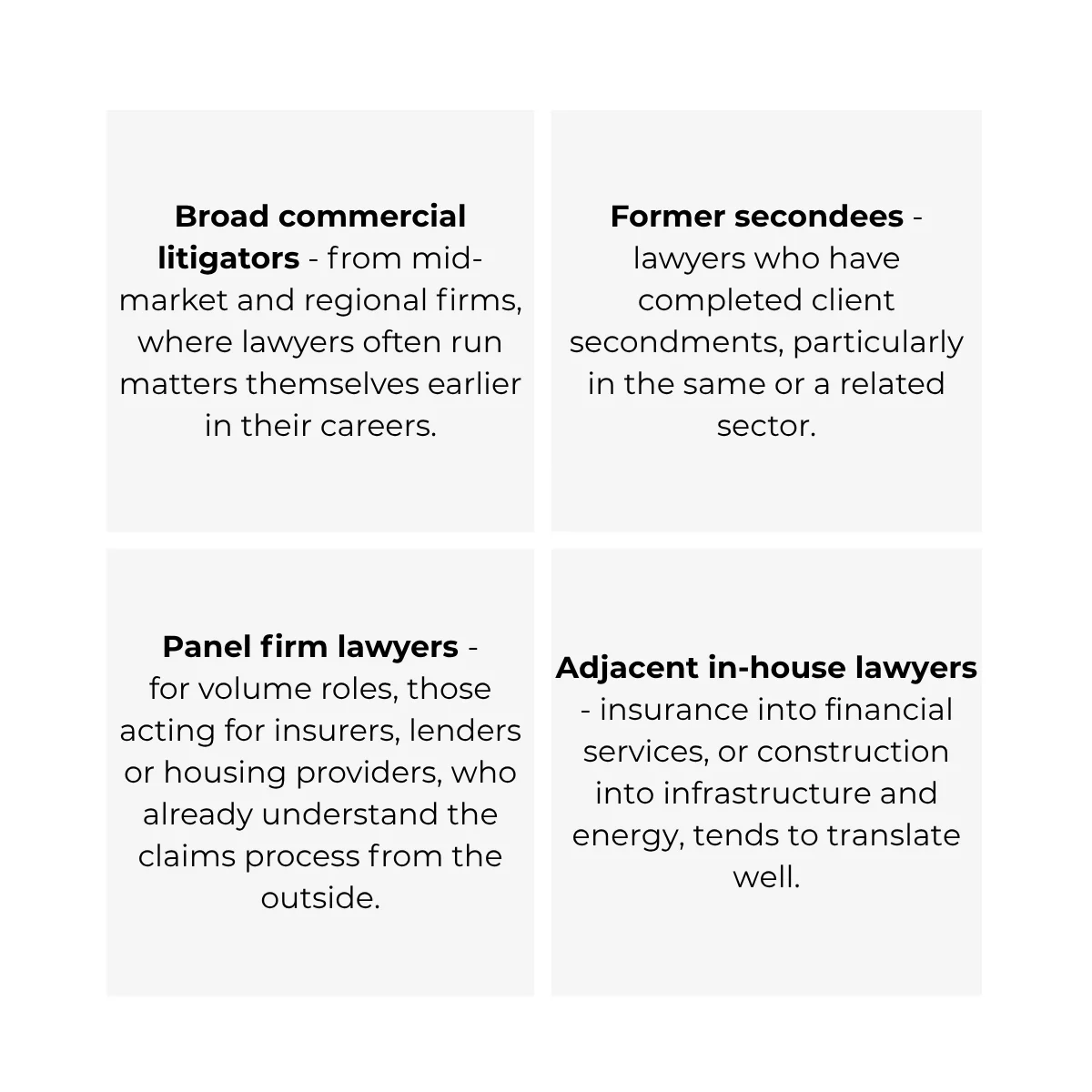
Whichever shape you choose, the in-house role differs from private practice. Less time goes on drafting and procedure, and more on deciding which disputes to fight, settle or avoid. The internal lawyer typically owns relationships with external firms, carries out early case assessment before any firm is instructed and reports to senior leadership on exposure and provisions. Preventative work, such as reviewing the contract terms that most often generate disputes or helping commercial teams resolve disagreements early, is a larger part of the role than many businesses expect, and is worth building into the brief.
Settling which shape you need before briefing the market makes the search more focused, because each attracts a different candidate pool. Contentious roles also fit a wider pattern in in-house hiring: experienced senior individual contributors who can operate independently tend to be the hires businesses prioritise and protect, even when hiring tightens elsewhere.
Private practice litigation has become increasingly specialised, with larger firms structuring disputes teams around competition litigation, fraud, insurance coverage, construction, intellectual property and financial services disputes. A business hiring internally rarely has a dispute profile that sits neatly within one of those niches.
A retailer might face supplier disputes, property claims, consumer complaints and occasional regulatory enforcement in the same year. A technology business might deal with contractual disputes, IP challenges, data claims and collective actions at once. The internal lawyer's job is often to recognise what a dispute is, how serious it is likely to become and who is best placed to handle it. That judgement draws on breadth, which is why commercial litigators with broad private practice caseloads often adapt well in-house.
Niche depth earns its place where exposure is concentrated:
Life sciences: a business with ongoing patent litigation.
Platforms: a business defending multiple claims in the Competition Appeal Tribunal.
Commodities: a trading house whose disputes run almost entirely through arbitration.
In these settings, the internal lawyer needs to engage with external specialists as a peer. The trade-off is flexibility: a specialist hired for one type of exposure may have less to contribute if the dispute profile changes. Some businesses pair a generalist internal lawyer with specialist external firms; others hire a specialist and accept a narrower remit. Both work. The choice often comes down to how stable your dispute profile is likely to be over the next few years.
Several backgrounds tend to transfer well into contentious in-house roles:
Broad commercial litigators: from mid-market and regional firms, where lawyers often run matters themselves earlier in their careers.
Former secondees: lawyers who have completed client secondments, particularly in the same or a related sector.
Panel firm lawyers: for volume roles, those acting for insurers, lenders or housing providers, who already understand the claims process from the outside.
Adjacent in-house lawyers: insurance into financial services, or construction into infrastructure and energy, tends to translate well.
Contentious experience can look similar on paper, so interviews that go beyond a list of cases tend to be more revealing:
Case mix: the range of disputes the candidate has run personally rather than supported.
Budgets: experience of setting and managing litigation budgets, and reporting against them.
Settlement judgement: for example, a scenario where a claim is winnable but costly to pursue.
Communicating risk: how they would explain a live dispute to a non-legal executive in a few minutes.
External counsel: how they select, challenge and hold firms to budget.
The settlement scenario is often the most informative. It shows whether a candidate weighs prospects of success alongside cost, time and commercial relationships, which is the balance in-house contentious work most often requires. It is also the conversation most likely to reassure a CFO or COO on the panel.
Contentious hires that work well tend to share one feature: the shape of the role matches the shape of the business's dispute profile. Businesses that first test whether the need is ongoing, then decide between a generalist, a hybrid, a case manager or a litigation lead, and weigh that against the cost of their current external spend, usually find both the search and the internal sign-off more straightforward.
If you're weighing up an in-house litigation hire, Dan Tudor, JMC's in-house legal recruitment specialist, can share current salary benchmarks from recent JMC placements and talk through how comparable businesses have structured the role.